
Introduction to Motorcycle Lifts
Maintaining a motorcycle requires more than basic tools and mechanical knowledge. Many repair and maintenance tasks become easier when the motorcycle is positioned at a comfortable working height. Whether someone owns a small commuter bike, a powerful sport motorcycle, or a heavy touring model, lifting equipment can make routine maintenance more convenient and efficient.
A motorcycle lift is a practical piece of equipment designed to raise a motorcycle off the ground and hold it securely while maintenance or repair work is performed. It provides better access to important components, including the wheels, suspension, brakes, engine, and underside of the frame.
Motorcycle lifts are commonly used in professional repair shops, motorcycle dealerships, private garages, and home workshops. They are available in several designs, ranging from compact manual stands to heavy-duty hydraulic platforms.
Choosing the right equipment depends on the motorcycle’s weight, frame design, available workspace, and the type of maintenance being performed. Understanding the different options can help motorcycle owners invest in equipment that offers convenience, stability, and long-term value.
What Is a Motorcycle Lifts?
A motorcycle lift is a mechanical device used to raise and support a motorcycle at a suitable working height. Depending on its design, it may lift the entire motorcycle, support one end, or raise a specific section of the bike.
Unlike ordinary parking stands, motorcycle lifts are designed to provide greater access for maintenance and inspection. Some models use hydraulic pressure, while others operate through manual screw mechanisms, foot-operated levers, or mechanical lifting systems.
Professional workshops often use wide lifting platforms that allow mechanics to access different parts of a motorcycle without repeatedly changing its position.
Smaller motorcycle lifts are particularly popular among home mechanics because they require less storage space and are generally more affordable.
Different Types of Motorcycle Lifts
Motorcycle lifts are available in several configurations. Each design offers specific advantages depending on the motorcycle and the intended application.
Hydraulic Motorcycle Lifts
A hydraulic motorcycle lift uses hydraulic pressure to raise a motorcycle with relatively little physical effort. Most designs feature a lifting platform, hydraulic cylinder, and foot-operated pumping mechanism.
The operator positions the motorcycle on the platform and uses the hydraulic system to raise it to the required height.
Hydraulic lifts are popular in professional workshops because they provide smooth lifting and can support substantial motorcycle weights when properly rated.
Some models also include locking mechanisms that hold the platform at different heights. This feature is important because the hydraulic system should not be the only support keeping a raised motorcycle in position.
Scissor Motorcycle Lifts
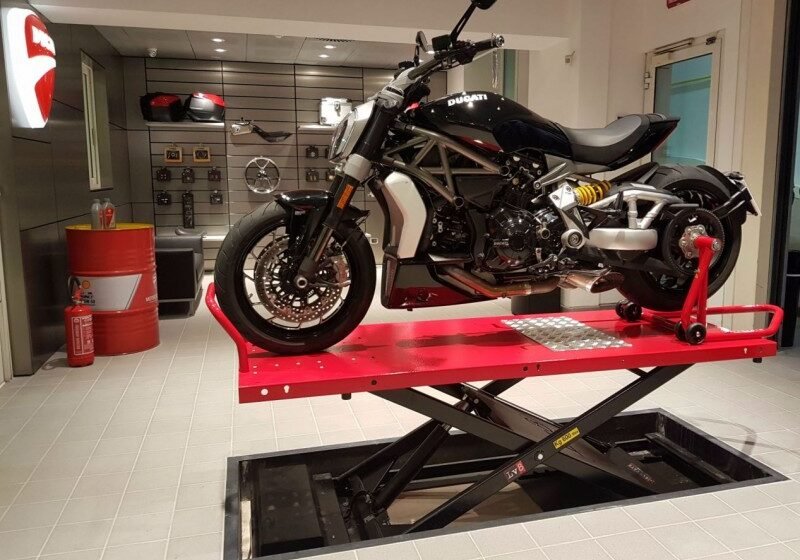
A scissor motorcycle lift uses a mechanical arrangement of crossed metal supports to raise a platform vertically.
As the lifting mechanism moves, the crossed supports expand and increase the platform height. Depending on the model, the mechanism may be operated through a hydraulic pump, screw system, or manual lever.
Scissor lifts are commonly used in home garages because their compact design makes storage easier.
They can be suitable for motorcycles, cruisers, dirt bikes, and other compatible models, provided the lifting points and weight capacity are appropriate.
Motorcycle Jack Lift
A motorcycle jack lift is designed to raise a motorcycle using a compact lifting mechanism positioned underneath a suitable support point.
These devices are especially useful when working on motorcycles that require access to the underside, wheels, or suspension components.
Motorcycle jacks are available in different sizes and weight capacities. Some are manually operated, while others use hydraulic mechanisms.
Before using a jack, it is important to identify the correct lifting points recommended by the motorcycle manufacturer.
Motorcycle Platform Lifts
A motorcycle platform lift provides a wide surface on which the motorcycle can be positioned and secured.
Professional versions often include a front wheel clamp, loading ramp, tie-down points, and a mechanical locking system.
These lifts are particularly useful for workshops that regularly service different motorcycle types.
The wider platform helps distribute the motorcycle’s weight and provides mechanics with a convenient working area.
Some platform lifts are designed for permanent workshop installation, while portable versions can be moved or stored when not in use.
Rear Motorcycle Lifts Stand
A rear motorcycle lift stand raises the rear wheel of a motorcycle while keeping the front wheel on the ground.
It generally uses two support points positioned near compatible swingarm or spool attachments.
Rear stands are popular among sport bike owners because they make chain cleaning, lubrication, rear-wheel inspection, and tyre maintenance easier.
They are relatively simple compared with full hydraulic platforms and are often a practical choice for routine home maintenance.
Front Motorcycle Lifts Stand
A front motorcycle lift stand is used to raise the front wheel of a motorcycle. Depending on the design, it may support the forks, steering stem, or another manufacturer-approved lifting point.
Front stands are useful when performing front-wheel maintenance, brake inspections, suspension work, or tyre replacement.
Some models require a rear stand to stabilize the motorcycle before the front end is lifted.
The correct stand must match the motorcycle’s front-end design.
Benefits of Using a Motorcycle Lifts
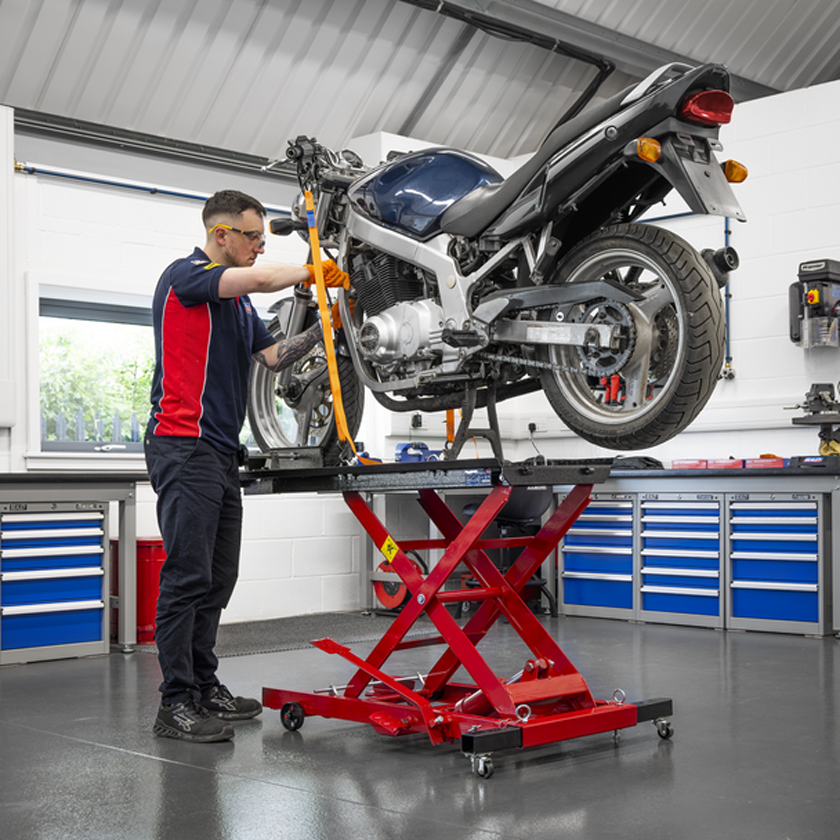
A motorcycle lift can improve the overall maintenance experience by providing a more convenient working position.
One of its biggest advantages is improved accessibility. When a motorcycle is raised, mechanics can reach components that are difficult to inspect or service while the bike is resting on its ordinary stand.
Another advantage is reduced physical strain. Working on a motorcycle at ground level often requires uncomfortable bending, kneeling, and stretching. A suitable lifting platform can bring the motorcycle closer to a comfortable working height.
Motorcycle lifts can also improve workshop organization. Mechanics can position a motorcycle in a designated service area and perform multiple maintenance procedures without constantly moving the bike.
For home mechanics, a suitable lift can make regular maintenance more manageable. Tasks such as cleaning, chain adjustment, wheel inspection, and certain repair procedures become easier when the motorcycle is properly supported.
How to Choose the Right Motorcycle Lifts
Selecting the right motorcycle lift requires careful consideration of several factors.
Motorcycle Weight Capacity
Weight capacity should be one of the first specifications to check. Different motorcycles have different weights, and a lift must be rated to support the complete load it is intended to carry.
A small dirt bike may require less lifting capacity than a large touring motorcycle or cruiser.
It is important to check the manufacturer’s maximum rated capacity rather than relying on appearance or general assumptions.
Choosing a lift with an appropriate safety margin can provide additional confidence during maintenance.
Lifting Height
The lifting height determines how far the motorcycle can be raised from its original position.
A low-profile lift may be sufficient for basic wheel and chain maintenance, while a taller platform may be more useful for professional mechanical work.
Before purchasing, consider the tasks that will be performed most frequently and the available ceiling and workspace clearance.
Platform Size and Stability
The platform should provide sufficient space for the motorcycle’s frame and approved lifting points.
A wider platform can improve convenience, but the motorcycle must still be positioned correctly to maintain balance.
Look for strong construction, suitable surface grip, secure mounting points, and reliable mechanical locks.
Stability is particularly important when working on heavier motorcycles.
Construction Materials
Motorcycle lifts are commonly manufactured using steel, aluminum, or combinations of different metals.
Steel lifts are popular because of their strength and durability. Aluminum designs may offer easier handling and lower overall weight.
The quality of welding, metal thickness, surface treatment, and moving components can influence long-term performance.
For frequent workshop use, construction quality should be a major purchasing consideration.
Manual or Hydraulic Operation
Manual lifts are generally simpler and may be suitable for occasional maintenance.
Hydraulic models reduce the physical effort required to raise a motorcycle and are often preferred for repeated workshop operations.
Electric lifts provide additional convenience but usually involve higher purchasing costs and electrical requirements.
The best choice depends on the frequency of use, budget, motorcycle weight, and available facilities.
Motorcycle Lifts Safety Considerations
Safety should always be a priority when lifting a motorcycle. Even a high-quality lift can become dangerous if it is incorrectly positioned or operated.
Before lifting, inspect the equipment for damaged welds, leaking hydraulic fluid, loose fasteners, or worn moving parts.
The motorcycle should be positioned according to the lift manufacturer’s instructions. Its centre of gravity must remain within the intended support area.
Use suitable wheel restraints and tie-down straps where required. These accessories help prevent unwanted movement during maintenance.
Always engage the mechanical safety lock before working underneath or around a raised motorcycle. Never depend exclusively on hydraulic pressure to support a motorcycle for an extended repair procedure.
The floor should be level, solid, and capable of supporting the combined weight of the motorcycle and lifting equipment.
It is also important to follow the motorcycle manufacturer’s recommendations regarding approved lifting points.
Motorcycle Lifts for Home Garages
A motorcycle lift can be a valuable addition to a home garage, especially for owners who enjoy maintaining their own bikes.
A compact scissor lift or suitable hydraulic jack may provide enough functionality for routine servicing without taking up too much space.
Rear and front stands are also useful options for sport motorcycles and compatible road bikes.
Before buying equipment, consider how much storage space is available and whether the lift will need to be moved regularly.
Home mechanics should also consider the motorcycle’s ground clearance, frame design, and compatibility with the selected lifting system.
A practical setup does not necessarily require expensive professional equipment. The most important factors are suitable capacity, stability, and correct application.
Motorcycle Lifts for Professional Workshops
Professional motorcycle workshops often require more capable lifting equipment because they handle different motorcycle categories and perform more demanding repair procedures.
A hydraulic platform lift can help technicians work efficiently throughout the day.
Features such as wheel clamps, loading ramps, adjustable platforms, and mechanical locking positions can make workshop operations more convenient.
For businesses, durability is especially important. Equipment used repeatedly should have reliable lifting components, accessible replacement parts, and clear maintenance instructions.
Choosing a suitable professional lift can improve the working environment and help technicians complete certain repair procedures more comfortably.
Motorcycle Lifts Maintenance
Regular inspection helps maintain the performance and safety of motorcycle lifting equipment.
Hydraulic models should be checked for oil leaks, damaged hoses, and unusual operating behaviour. Hydraulic fluid should be maintained according to the manufacturer’s recommendations.
Mechanical lifting systems should be inspected for worn threads, damaged joints, loose bolts, and other signs of deterioration.
The platform and support surfaces should be kept clean to prevent dirt and oil from reducing grip.
Moving components may require lubrication at recommended intervals. Any damaged locking mechanism should be repaired before the lift is used again.
Following the manufacturer’s maintenance schedule can help extend equipment life and reduce the risk of unexpected problems.
Common Mistakes When Buying a Motorcycle Lifts
One common mistake is purchasing a lift based only on its price. Although inexpensive equipment may appear attractive, poor construction and insufficient weight capacity can create serious problems.
Another mistake is ignoring motorcycle compatibility. Not every lift works with every frame design, exhaust arrangement, or ground clearance.
Some buyers also overlook the importance of a mechanical locking system. A reliable safety lock is essential when a motorcycle remains raised during maintenance.
Finally, it is important not to confuse a parking stand with a full motorcycle service lift. Both products have different purposes, and the correct option depends on the work being performed.
The Future of Motorcycle Lifting Equipment
Motorcycle workshop equipment continues to evolve as manufacturers introduce more convenient and efficient lifting solutions.
Electric hydraulic systems, improved safety locks, adjustable platforms, and compact storage designs are becoming important considerations for modern workshops.
Manufacturers are also focusing on improved construction materials and more versatile lifting mechanisms.
As motorcycle ownership and independent maintenance continue to attract enthusiasts, practical workshop equipment will remain an important part of the motorcycle service industry.
Final Thoughts
A motorcycle lift is a useful investment for anyone who regularly performs motorcycle maintenance or operates a repair workshop. It provides better access to important components, reduces physical strain, and makes many servicing procedures more convenient.
From compact rear stands and motorcycle jacks to advanced hydraulic platform lifts, there are options available for different motorcycles and working environments.
The right equipment should match the motorcycle’s weight, frame design, lifting requirements, and available workspace. Construction quality, safety locks, platform stability, and manufacturer support should also influence the purchasing decision.
With proper selection, correct operation, and regular maintenance, a motorcycle lift can become a valuable long-term addition to any motorcycle garage.
Frequently Asked Questions
What is a motorcycle lifts used for?
A motorcycle lift raises and supports a motorcycle to provide easier access for maintenance, inspection, cleaning, and repair work.
Which motorcycle lift is best for home use?
A compact scissor lift, hydraulic motorcycle jack, or compatible front and rear stands can be suitable for home garages. The right choice depends on the motorcycle and maintenance requirements.
Are hydraulic motorcycle lifts better than manual lifts?
Hydraulic lifts generally require less physical effort and are convenient for frequent use. Manual lifts are often simpler and may be suitable for occasional maintenance.
How much weight can a motorcycle lifts support?
Weight capacity varies by model. Some compact lifts are designed for smaller motorcycles, while heavy-duty platforms can support substantially heavier bikes. Always follow the manufacturer’s rated capacity.
Can a motorcycle lifts be used for a sportbike?
Yes. Many lifts are suitable for sportbikes, but compatibility with the frame, swingarm, steering stem, and approved lifting points must be checked.
Is a motorcycle lifts safe?
A motorcycle lift can be safe when correctly rated, properly positioned, and used according to the manufacturer’s instructions. Mechanical safety locks and suitable restraints are important.
What is the difference between a motorcycle jack and a motorcycle lift?
A motorcycle jack generally raises a specific section or lifting point, while a motorcycle lift may provide a larger platform for supporting the entire motorcycle.
How do I maintain a hydraulic motorcycle lift?
Inspect hydraulic components for leaks, check mechanical locks and fasteners, keep the platform clean, and follow the manufacturer’s recommended maintenance schedule.